
10 Best Practices for Multi-Account Management in 2026
Practical strategies for keeping multiple accounts separated and safe: unique identities, dedicated proxies, anti-detect browsers, separate payments, warm-ups, and centralized monitoring.

10 Best Practices for Multi-Account Management in 2026
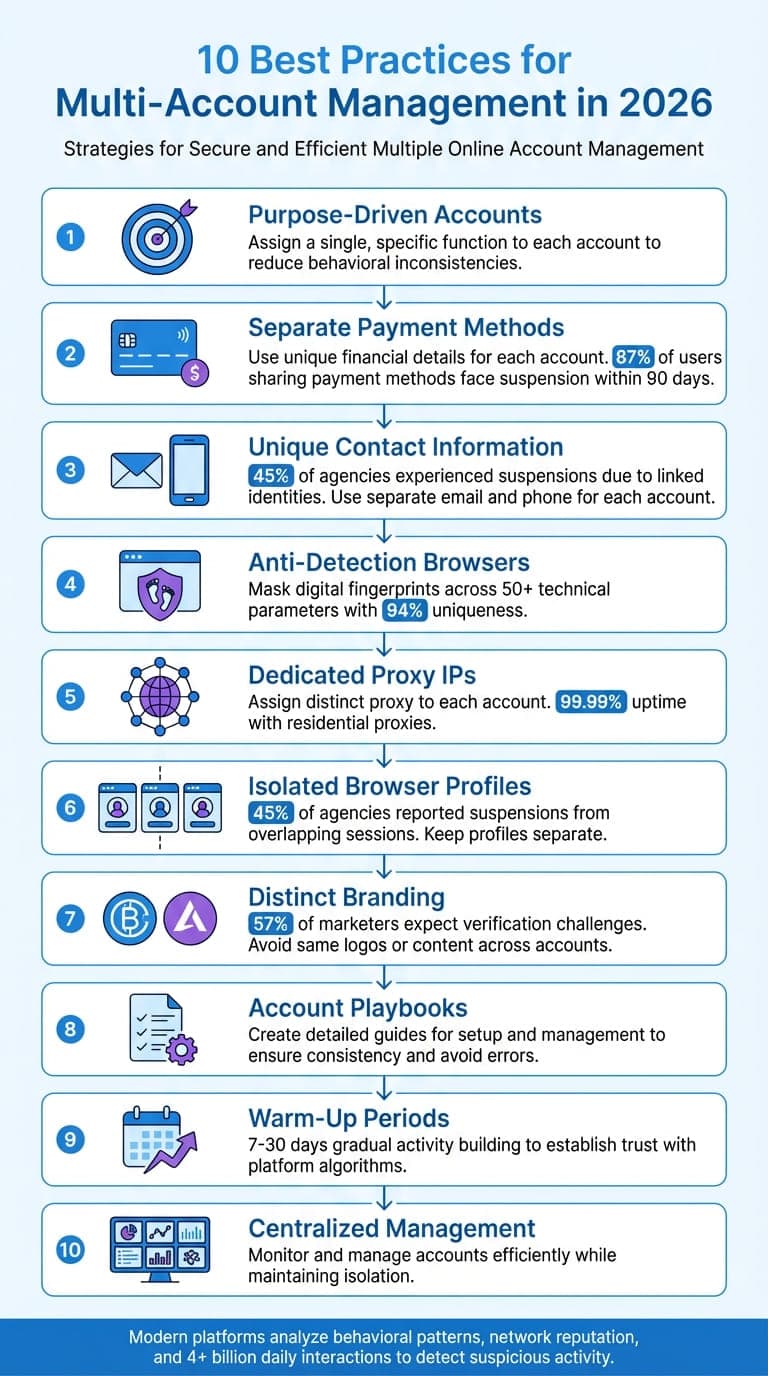
Managing multiple online accounts in 2026 is more challenging than ever. Advanced detection systems on platforms like Facebook, Google, and Amazon make it critical to follow strict practices to avoid account bans and linking. These 10 strategies help protect your accounts and streamline management:
- Purpose-Driven Accounts: Assign a single, specific function to each account to reduce behavioral inconsistencies.
- Separate Payment Methods: Use unique financial details for each account to avoid linking through shared payment data.
- Unique Contact Information: Ensure every account has its own email and phone number to prevent detection during verification.
- Anti-Detection Browsers: Use tools that mimic different devices to mask digital fingerprints and isolate accounts.
- Dedicated Proxy IPs: Assign a distinct proxy to each account to separate network activity.
- Isolated Browser Profiles: Keep accounts separate by using different profiles or devices to avoid cross-linking.
- Distinct Branding: Avoid using the same logos or content across accounts to prevent detection through visual clues.
- Account Playbooks: Create detailed guides for account setup and management to ensure consistency and avoid errors.
- Warm-Up Periods: Gradually build account activity over time to establish trust with platform algorithms.
- Centralized Management: Use dashboards to monitor and manage accounts efficiently while maintaining isolation.
10 Best Practices for Multi-Account Management in 2026
1. Define a Clear Purpose for Each Account
Each account in your portfolio should have a specific, singular function. For example, an account used for ad management shouldn’t double as a web scraping tool, and an e-commerce seller account shouldn’t overlap with a social media profile. Keeping these roles separate isn’t just about staying organized - it’s crucial for working with 2026’s advanced detection systems. By giving each account a distinct purpose, you can ensure consistent behavior that aligns with platform expectations.
Platform Compliance and Detection Systems
Today’s platforms use advanced detection systems that can flag accounts with inconsistent or erratic behavior. For example, if a social media account suddenly starts running automated scripts or an e-commerce account shifts between unrelated tasks like product research and customer service, it creates a behavioral profile that raises red flags.
Take the case of "SocialScale", a boutique agency managing 12 high-profile brand accounts on Threads in December 2025. Initially, they operated all accounts from a standard browser. When one account was flagged for a copyright violation, the platform’s detection system linked their accounts through shared IP addresses and browser fingerprints. Within 48 hours, three additional accounts faced restrictions. To resolve this, SocialScale switched to using dedicated antidetect browser profiles and residential proxies for each account. This adjustment not only stopped further penalties but also saved them 5 hours of work per week. Keeping accounts isolated by purpose proves critical in avoiding such risks.
Reducing Risks of Bans and Account Linking
Accounts with a clear, defined role tend to exhibit the kind of consistent behavior that platforms expect. For instance, a business account that posts only during working hours, uses professional language, and interacts with industry-relevant content appears more legitimate. On the flip side, an account juggling personal browsing, ad campaigns, and automated tasks can create behavioral inconsistencies that detection systems are quick to notice.
Improving Efficiency and Scalability
When accounts have clearly defined roles, it’s easier to choose the right tools and infrastructure for each one. For example:
- Residential proxies work well for high-value social media accounts, as they mimic real user behavior.
- Datacenter proxies are better suited for tasks like high-speed data scraping, where efficiency is key.
Additionally, tailoring digital fingerprints to each account’s purpose is essential. Some operations may require stable desktop configurations, while others might need mobile device emulation to maintain a consistent and distinct identity. Without clear purposes, you risk wasting resources or exposing accounts to unnecessary detection, which can undermine your entire operation.
2. Use Separate Payment Methods and Financial Details
Sharing financial information across multiple accounts can quickly lead to account suspensions. Services like PayPal and Stripe utilize advanced fraud detection systems that flag shared credit cards or bank accounts as direct connections between profiles. Using the same payment method creates an undeniable link, making financial separation a must to avoid mass suspensions.
Risk Mitigation for Bans or Account Linking
When one account gets flagged, platforms often suspend all accounts linked to it. PayPal, for example, can freeze connected accounts within 48 hours if they share financial details or browser fingerprints. Once suspended, funds are frequently held for up to 180 days during the investigation period. This ripple effect can severely impact businesses relying on multiple accounts for different brands or regions. Keeping accounts isolated is a critical part of anti-detection strategies for managing multiple profiles effectively.
"Using the same credit card or bank account across multiple PayPal accounts creates a direct, undeniable link." - Robin Brown, Nstbrowser
Platform Compliance and Anti-Detection Effectiveness
Modern platforms have moved beyond basic rule-based systems. They now analyze session data, behavioral patterns, and historical activity to identify connections between accounts. A staggering 87% of users managing multiple PayPal accounts with only basic tools like VPNs face suspension within 90 days. To protect your accounts, complete financial isolation is essential. Each account should have its own credit card, bank account, billing address, and verification documents. Virtual card services can generate unique card numbers, while separate business bank accounts provide stronger financial separation for high-value operations.
Security and Privacy Protection
Financial isolation doesn’t just protect individual accounts - it safeguards your entire operation. If one account faces issues, others remain unaffected by automatic flags or freezes. This approach also helps maintain clear boundaries between personal and business finances, simplifying both accounting and risk management. For teams managing multiple brands, assigning distinct legal entities with unique documentation ensures each account is treated as an independent business by platform verification systems.
3. Set Up Unique Email Addresses and Contact Information
Using shared email addresses or phone numbers can create connections that platforms detect almost immediately. During the verification process, platforms compare registration data, and any duplication can lead to accounts being automatically linked.
Reducing Risks of Bans and Account Linking
A 2025 study revealed that 45% of agencies experienced account suspensions due to linked identities, making unique phone numbers critical. For example, while Google permits one phone number to verify up to five Gmail accounts, this approach introduces a single point of failure. If one account is flagged, all accounts tied to that number could face suspension.
"Having a separate phone number for each account is safer because if one account is banned, the others might remain unaffected." - Joanna Ok., Content Writer and Marketing Strategist, Multilogin
This underscores the importance of individualized verification details as part of a broader anti-detection strategy.
Ensuring Platform Compliance and Avoiding Detection
To avoid detection, every account must have its own unique verification identity. Platforms increasingly rely on device fingerprinting to verify users. This means each account needs its own email, phone number, and recovery information to stay truly independent. Using real SIM-based phone numbers is crucial, as virtual numbers are more likely to be flagged and could lead to immediate restrictions. Instead of storing recovery emails and 2FA codes in a centralized location, save them within each browser profile’s notes section to avoid accidental cross-linking.
Strengthening Security and Privacy
Having unique emails and passwords for each account ensures that a breach in one account won’t compromise others. This practice, combined with isolated contact details, bolsters defenses against cross-account detection. Each email account should work independently, with its own profile, cookies, and IP address to maintain complete separation.
4. Use Anti-Detection Browser Technology
Once you've set up unique contact details, the next step is to mask your digital fingerprint. By 2026, platforms analyze over 50 technical parameters - like Canvas, WebGL, AudioContext, and hardware specs - to create a fingerprint that's over 94% unique for most users. Traditional browsers generate identical fingerprints across accounts, making it easy for platforms to link them together.
This step strengthens your earlier efforts to isolate accounts, adding another layer of protection.
Platform Compliance and Anti-Detection Effectiveness
Anti-detection browsers tackle this issue by creating isolated environments where every profile mimics a completely different device. Platforms now employ advanced methods like JA3/JA4 and HTTP/2 fingerprinting at the transport layer. So, older techniques like using VPNs or clearing cookies no longer cut it.
"A VPN hides where you are. An antidetect browser hides what device you are. These solve different problems and are typically used together." - Chameleon Mode
The key is not to introduce too much randomness in your fingerprint. In 2026, excessive "noise" in fingerprints can itself become a red flag. The most effective anti-detection browsers rely on databases of real device configurations to create stable, realistic profiles. Ensure your timezone, language, and geolocation settings match your proxy IP to avoid raising suspicion.
Operational Efficiency and Scalability
Anti-detection browsers can streamline multi-account management. Instead of relying on physical devices or resource-intensive virtual machines, tools like GoUndetected let you manage hundreds of isolated profiles from one centralized dashboard. Features include unique browser fingerprints, IP cloaking, encrypted sessions, and built-in automation tools. With RPA (Robotic Process Automation) and synchronizers, you can mirror profiles and minimize repetitive tasks.
Risk Mitigation for Bans or Account Linking
Each browser profile operates in a sandboxed environment with isolated cookies, storage, cache, and session data. This isolation ensures that if one account gets flagged, others remain unaffected, as platforms can't easily link them. Additionally, team collaboration features allow you to share account access securely through role-based permissions, avoiding the need to disclose login credentials. Before accessing sensitive accounts, always verify your proxy status and fingerprint configuration using the browser's built-in dashboard checks. This step ensures your defenses are solid and minimizes the risk of detection.
5. Use Dedicated Proxy IPs
Your anti-detection browser might create unique fingerprints, but without dedicated proxies, all accounts still share the same IP address. This is a problem because platforms rely heavily on IPs for geo-targeting, rate-limiting, and identifying suspicious activity. For example, accessing 50 accounts from a single IP is a surefire way to get flagged. After setting up unique fingerprints, pairing them with dedicated proxy IPs ensures a complete anti-detection strategy.
Platform Compliance and Anti-Detection Effectiveness
Residential proxies are a reliable choice as they use real IPs assigned by internet service providers. They’re highly effective at avoiding detection. Mobile proxies, on the other hand, route traffic through carrier networks like 3G, 4G, and 5G, offering an even higher level of protection. These proxies are especially useful for sensitive platforms like Meta, TikTok, and Google Ads because banning mobile IPs would inadvertently affect legitimate users.
"Fingerprint separates the device; proxy separates the network." - Kameleo
ISP (static residential) proxies combine the authenticity of residential IPs with the speed of datacenters, making them a strong option for managing accounts over the long term. However, datacenter proxies are less reliable for high-stakes tasks, as their IP ranges are often flagged by platforms. To avoid detection, ensure your proxy's region matches the account's origin, and confirm that the IP isn’t blacklisted.
Risk Mitigation for Bans or Account Linking
Each account should have its own dedicated proxy. Sharing a proxy across multiple accounts creates a connection between them, increasing the risk of a chain ban.
"If you are running 50 accounts from the same IP, you are essentially telling the platform that 50 different people are all using the same public Wi-Fi hotspot. This is a massive red flag that will trigger chain bans." - Multilogin
Premium residential proxies offer impressive reliability, with 99.99% uptime and sticky sessions lasting up to 24 hours to simulate natural user behavior. Around 95% of these residential IPs have clean histories, reducing the chance of being flagged in spam or security databases. GoUndetected simplifies proxy integration, allowing you to assign a dedicated IP to each profile directly from its dashboard. Before diving in, always test your proxy setup to confirm that your time zone, geolocation, and WebRTC settings align with your proxy IP.
6. Separate Accounts Across Different Devices or Browser Profiles
Building on earlier strategies, keeping accounts isolated by using different devices or browser profiles is a smart way to avoid digital cross-linking. If you rely on a single browser for all accounts, you risk creating patterns that platforms can easily detect. Without proper separation, browser data can link accounts together.
Platform Compliance and Anti-Detection Measures
Modern platforms have become highly sophisticated in tracking unique device parameters. When multiple accounts share matching signals, it raises red flags. Anti-detection browser technology addresses this issue by creating isolated profiles - essentially a "clean browser bubble" - where each account has its own distinct digital identity. This separation is crucial for avoiding cross-account linking, which could compromise the security measures we've discussed earlier.
The statistics are telling: in 2025, 45% of agencies reported at least one account suspension due to overlapping sessions. Additionally, over 70% of websites now use device fingerprinting to detect fraud and verify users. Platforms have moved beyond simple rule-based systems, now analyzing behavioral patterns, network reputations, and session consistencies to identify suspicious activity.
Efficiency and Scalability
Using physical devices for each account is unrealistic when managing dozens - or even hundreds - of accounts. Browser profiles provide the same level of separation without requiring additional hardware. For example, GoUndetected allows users to create unlimited profiles (depending on the chosen plan), each with its own fingerprint, cookies, and proxy settings - all manageable from a single dashboard.
This setup also makes it easier for teams to access accounts from different locations without triggering "suspicious login" alerts or needing to share raw passwords.
Reducing Risks of Bans or Account Linking
To maintain account security, each profile must operate independently. The "one account, one profile" rule is non-negotiable. When platforms detect shared device signals between accounts, a single violation can lead to a chain ban, jeopardizing your entire operation. A real-world example: In December 2025, SocialScale, a boutique agency, faced this issue when Meta flagged one of their 12 Threads accounts for a copyright violation. Because three other accounts shared the same digital fingerprint and IP address, Meta restricted those accounts as well. After switching to isolated profiles with dedicated proxies, the agency saved an estimated 5 hours per week on account recovery tasks.
"Account linking and bans are no longer 'edge cases' - they are the default risk." – IPFoxy
Before starting any live session, double-check that your profile settings match the proxy location. Avoid reusing browser extensions or importing cookies across profiles - these small oversights can act as identifiers that link accounts together.
7. Maintain Different Branding and Product Lines
Keeping your branding distinct is not just about marketing - it’s also a smart way to protect your accounts. Platforms often rely on visual and content-based clues to figure out if multiple accounts are run by the same person or company. Using the same logos, product photos, or descriptions across accounts can leave a trail that’s easy to follow, potentially linking your accounts together. Just like using separate contact details and proxies, unique branding helps keep your accounts unconnected and harder to detect.
Platform Compliance and Anti-Detection Strategies
Detection systems have become more sophisticated, going far beyond simple IP tracking. They now utilize AI-powered behavioral analysis to spot patterns that might link accounts. For instance, if two accounts use identical product images or ad creatives, platforms may flag them as suspicious. To avoid this, each account should have its own distinct "digital fingerprint." This means customizing technical settings and ensuring that each account operates independently.
A recent study highlighted that 57% of marketers expect account verification to become a bigger challenge by 2025. This is because platforms are combining device fingerprinting with behavioral checks to ensure consistency. If your accounts share overlapping parameters, they’re more likely to be linked. To stay compliant and undetected, ensure each brand operates with stable, separate configurations across sessions.
Reducing Risks of Bans or Account Linking
Distinct branding acts as a safety net. If one account gets flagged for a policy violation or even banned, having separate branding and product lines can stop the problem from spreading to your other accounts. Without this separation, a single flagged account could lead to a chain reaction, resulting in multiple accounts being suspended due to shared digital signals.
To put this into practice, make sure every brand has its own unique registration details. This includes using different names, email addresses, payment methods, and phone numbers. Also, match your proxy location with the country code of the phone number and the origin of the payment card. Before you launch a new branded account, spend some time building a natural browsing history to generate organic cookies. This "warm-up" phase makes the account appear more legitimate to platform algorithms.
8. Create and Follow Account-Specific Playbooks
A playbook is essentially your step-by-step guide for setting up, accessing, and managing accounts. Without one, you're left relying on memory and guesswork, which can lead to errors that might link your accounts together. A solid playbook should cover everything - technical setup like fingerprints, proxies, and payment methods, as well as behavioral rules like warm-up timelines and posting schedules. It also needs to outline team access protocols. This approach ties directly into the technical and behavioral measures discussed earlier.
Platform Compliance and Anti-Detection Effectiveness
Modern platforms are incredibly sophisticated when it comes to identifying users. They track over 50 different parameters, including Canvas hashes, WebGL rendering, AudioContext signatures, screen resolution, and even user behavior patterns. This process, often referred to as fingerprint emulation, creates a unique profile for each account. It's far more effective than basic masking techniques, which platforms can easily detect. By formalizing strategies like proxy usage, device fingerprinting, and session consistency, playbooks ensure these isolation methods are consistently applied.
Here’s the golden rule: one profile per IP. For example, if your proxy shows an IP address in New York but your browser is set to Los Angeles time, that mismatch could flag your account for review. Using sticky sessions - where the same IP is maintained for up to 24 hours - helps avoid raising red flags.
Operational Efficiency and Scalability
Playbooks don’t just protect your accounts - they also make managing them more efficient. When you're juggling dozens or even hundreds of accounts, standardized procedures save time and reduce errors. A clear system allows your team to work independently without constant supervision. Implementing role-based access control (RBAC) ensures that team members have appropriate permissions. For instance, a "Manager" might handle account settings, while an "Employee" is restricted to posting content.
Automation tools like RPA, Selenium, or Puppeteer can take over repetitive tasks, ensuring consistency and saving time. These tools also help mimic human-like behavior, reducing the risk of actions that might expose account links.
Risk Mitigation for Bans or Account Linking
The biggest threat in multi-account management is cross-contamination - when data from one account overlaps with another. A robust playbook should enforce strict environment isolation. Never reuse the same browser profile across different accounts, even briefly.
"If a platform detects that your profiles share a weak or inconsistent digital fingerprint, they can link all your accounts together... a ban on one account can quickly cascade to all your others." – Luke Ulyanov, Nstbrowser
Your playbook should also include a warm-up phase for new accounts. This involves browsing relevant sites to build organic cookies and establish a credible activity history before launching ad campaigns or monetization efforts. When importing existing accounts, consider using pre-farmed cookies to bypass early security checks. Additionally, maintain audit logs to track who accessed each account and what actions they performed. These logs are invaluable for troubleshooting issues.
9. Allow Warm-Up Time Before Monetization
Platform Compliance and Anti-Detection Effectiveness
Jumping straight into monetization can set off alarms in platform security systems. Take Facebook as an example - it processes over 4 billion interactions every day, constantly refining its bot-detection algorithms based on user behavior patterns. These systems don’t just monitor what you do but also how and where you do it.
"Warming up means gradually building trust with platform algorithms. Instead of instantly creating an account and running ads... you slowly act like a genuine user." - Joanna Ok., Multilogin
A warm-up period of 7–30 days allows your account to develop a natural browsing history and behavioral profile. This step ties back to earlier strategies that emphasize building authentic activity patterns before engaging in riskier actions like monetization.
Risk Mitigation for Bans or Account Linking
Stretching out the warm-up process helps establish a more authentic digital footprint, reducing the likelihood of bans or account linking. A phased approach works best:
- Week 1: Focus on passive browsing and completing your profile setup.
- Week 2: Add light engagement - 3–5 likes per day and join 1–2 groups.
- Week 3: Gradually increase activity by liking 8–10 posts, creating original content, and starting conversations through messaging.
- Week 4: Begin commercial activities, such as connecting to your Ad Manager.
Automated tools like CookieRobot can help mimic natural user behavior by visiting popular websites and interacting with tracking elements. This builds a more authentic online presence. Don’t forget to use proxies that align with previous recommendations - datacenter IPs, for instance, are more likely to draw unwanted attention. A gradual warm-up process not only strengthens your account’s credibility but also fits seamlessly into a multi-account management strategy.
10. Set Up Centralized Management and Monitoring Systems
Operational Efficiency and Scalability
Trying to manage dozens - or even hundreds - of accounts manually? That’s a recipe for chaos. A centralized dashboard changes the game by giving you control over all your browser profiles in one place. No more jumping between devices or profiles - everything is streamlined and easier to handle.
With synchronizer tools, you can execute tasks across multiple browser windows at the same time. This eliminates repetitive manual actions and saves you a ton of effort. Bulk management features are another lifesaver, letting you import, export, and clone profiles in batches or assign proxies in a single step. This not only slashes setup time but also makes scaling up operations much more manageable. Plus, by centralizing management, you reduce the chances of accounts being linked, which is crucial for keeping them secure.
Risk Mitigation for Bans or Account Linking
Centralized systems don’t just make life easier - they’re also key to protecting your accounts. By keeping each profile completely isolated with its own cookies, cache, and storage, these systems ensure no accidental session overlap. At the same time, they give you a unified view to monitor everything in real time.
With real-time dashboards, you can check the status of each profile before activation. This includes verifying proxy health, ensuring IP locations match your target geography, and confirming that digital fingerprints are properly set up. If there’s a proxy or IP mismatch, the dashboard flags it immediately so you can fix it on the spot. Role-based access control adds another layer of security, letting team members manage accounts without needing access to sensitive credentials.
Comparison Table
Choosing the right tools for managing multiple accounts effectively requires understanding how specific features contribute to security, isolation, and ease of use. Here's a breakdown of essential tool categories and how a solution like GoUndetected tackles these needs:
Tool Type | Example / Integration | Starting Price | Best For | Key Advantage |
|---|---|---|---|---|
Anti-Detection Browser | GoUndetected | $39/mo for 50 profiles* | Social media managers, e-commerce sellers, advertisers | Advanced fingerprint spoofing (Canvas, WebGL, Audio, etc.), built-in proxy support, and 24/7 expert help |
Integrated Proxy Management | In-app built-in proxies | Included in your subscription | Secure operations on platforms with strict anti-fraud measures | Automatic IP isolation for each profile, minimizing detection and ban risks |
Centralized Account Oversight | Integrated management dashboard | Varies by solution | Teams handling large account portfolios | Simplified segmentation and unified security policies across all accounts |
*The Agency plan for GoUndetected supports unlimited profiles at $699/mo.
Conclusion
Handling multiple accounts in 2026 requires a mix of reliable tools and disciplined strategies. Modern platforms now rely on advanced techniques like fingerprint analysis and behavioral tracking, meaning even the best antidetect browsers can fail if login patterns are too similar. As discussed earlier, maintaining technical isolation and operational discipline is non-negotiable.
The guiding rule of "one profile, one IP" continues to be a cornerstone of secure account management. A recent case showed how just one misstep - such as reusing an IP - can lead to a chain reaction of account bans, emphasizing the need for dedicated proxies and isolated profiles.
Data also reveals that overlapping sessions significantly raise the risk of mass suspensions. To counter this, using unique hardware and network identifiers, along with separate contact and financial details, is more critical than ever. Centralized management systems further help streamline operations while ensuring profiles remain isolated and secure.
Together, these strategies create a strong defense against detection, aligning with the core principles outlined in this article. Professionals know that security and efficiency go hand in hand, and tools like GoUndetected are designed to meet these dual demands. Whether you're running social media campaigns or managing complex e-commerce operations, these practices provide the layers of protection required in today’s digital environment. By mastering these methods, you can ensure your multi-account operations stay secure and adaptable in an ever-changing online landscape.
FAQs
What steps can I take to ensure my accounts stay unlinked and undetected?
To prevent your accounts from being linked or flagged by detection systems, consider using an antidetect browser. These browsers let you create separate profiles, each with its own distinct digital fingerprint, making it look like each account is managed by a different person.
Pair this with proxy setups to assign unique IP addresses to each account. Additionally, ensure your browsing habits resemble natural human behavior. By isolating accounts and disguising your identity, you can lower the chances of detection and protect your privacy.
What are the best ways to use proxies for managing multiple accounts?
To manage multiple accounts effectively using proxies, the first step is selecting the right type of proxy. Residential proxies are a popular choice because they use real user IP addresses, making them harder to detect. For platforms with strict anti-bot systems, mobile proxies can be a smart alternative since they route traffic through mobile carriers, closely resembling genuine user behavior.
To further protect your accounts, pair your proxies with anti-detect browsers and tools designed to manage device fingerprints. This setup helps prevent accounts from being linked and keeps your activities private. Choose rotating proxies for added anonymity, as they change IPs frequently, or static proxies for platforms that require consistent sessions. It’s also crucial to regularly test your proxies for reliability, confirm they’re not blacklisted, and ensure their digital fingerprint doesn’t match known bot patterns.
By integrating proxies with robust fingerprint management and anti-detection tools, you can reduce risks, prevent account bans, and manage your multi-account operations more efficiently.
Why should each account have a specific purpose?
Assigning a clear purpose to each account is key to staying organized and maintaining security. It helps streamline activities, lowers the chances of detection or bans, and ensures every account operates with consistent and distinct behavior.
When you define specific roles for your accounts, you reduce overlap, limit mistakes, and safeguard sensitive information more effectively. This is especially crucial in fields like social media, e-commerce, or advertising, where privacy and compliance play a major role.
Browse Undetected. Stay Private.
Unique browser fingerprints, built-in proxy support, and anti-detection technology. Try GoUndetected free for 7 days.
Available for macOS and Windows · No credit card required